
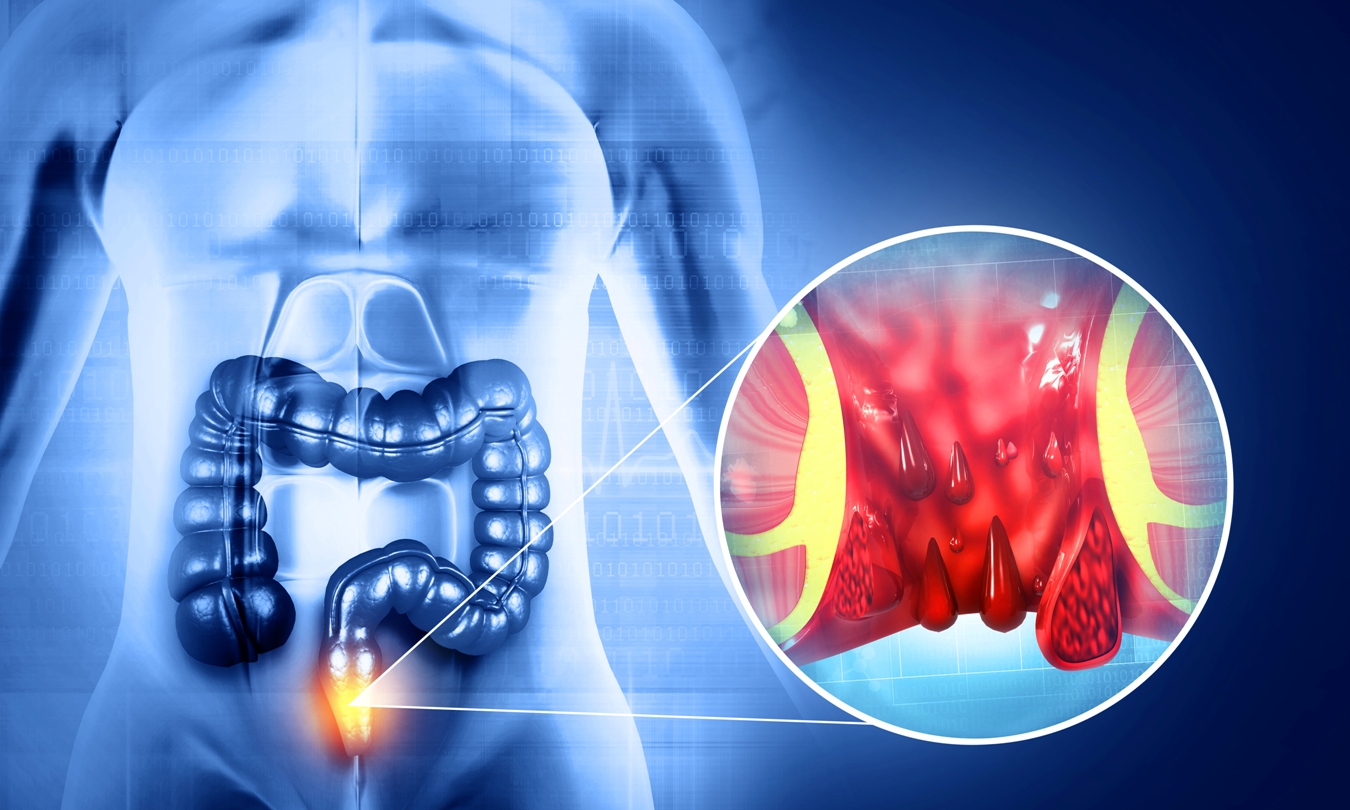
The word haemorrhoids is widely used to describe the condition called hemorrhoidal disease. In fact, haemorrhoids are present to all people, as they are a complex of vessels normally located in the lower part of the large intestine, just before the anus. Due to various factors, these vessels can get widen, that is, swell and cause certain unpleasant symptoms.
It is estimated that by the age of 50, about 50% of the population has experienced one or more of the symptoms of the condition. Although it is a harmless condition, haemorrhoids are extremely unpleasant for the sufferer. Fortunately, today we have quite a wide variety of treatment options to treat it and permanently restore the problem.
What are haemorrhoids?
Haemorrhoids are a normal anatomical formation in the wall of the anorectal canal. They form a grid of blood vessels, whose function is to form so-called “anatomical pillows” in the process of defecation. Haemorrhoids contract during the process of defecation, facilitating the passage of stool, and dilate again, at the end of it.
Over time, and especially due to specific aggravating factors, haemorrhoids can swell to such an extent that they detach from the surface of the tissues that hold them in place and prolapse and even form clots. It is at this point that hemorrhoidal disease begins with all the unpleasant consequences that accompany it.
Types of haemorrhoids
Normal hemorrhoidal tissue is not visible and appears when the haemorrhoids “swell” and start showing symptoms. Their distinction is made based on the position in which they are located, as well as the stage in which the disease is located.
Based on the position we distinguish 2 categories:
- Internal haemorrhoids
They are located in the rectum and in their early stages are not always apparent.
- External haemorrhoids
They are located under the skin of the anus.
Stages of haemorrhoids
- Haemorrhoids 1st Stage
Hemorrhoidal nodules are located inside the last part of the large intestine and are not visible. The only signs that indicate their presence are the presence of a small amount of blood during bowel movement and an annoying sensation of itching.
- Haemorrhoids 2nd Stage
Hemorrhoidal nodules become apparent after defecation, but they reduce inside the bowel after a while.
- Haemorrhoids 3rd Stage
The nodules prolapse outside the anal canal and are not automatically reduced, but their mechanical reduction (manual repositioning by the patient) is possible.
- Haemorrhoids 4th Stage
Haemorrhoids are permanently located outside the anus and cannot be reduced.
What are the causes of haemorrhoids?
Swelling of normal haemorrhoids occurs when there is an increase in pressure in the hemorrhoidal vascular plexus. There are many factors involved, the main one being defecation disorders. Laborious defecation is the major cause of haemorrhoids, indirectly placing diet in the list of causes.
Other causes that could contribute to the onset of the condition are:
- Obesity
- Chronic diarrhoea
- Old age
- Hereditary predisposition
- Intense and continuous physical exercise with lifting heavy objects
- Pregnancy or a particularly laborious childbirth
When to visit your doctor?
Haemorrhoids are an extremely unpleasant condition, but they are not dangerous. Most people can recognize some of the symptoms and follow a conservative treatment on their own, which may be effective for early-stage haemorrhoids.
However, this can sometimes hide greater risks than the condition itself. Under no circumstances should the patient arbitrarily assume that rectal bleeding is due to haemorrhoids, thus postponing medical review. Rectal bleeding is a symptom of swollen haemorrhoids, but it is also a symptom of other diseases, including colon and rectal cancer.
Therefore, the most appropriate thing is for the patient to seek medical advice the first moment he notices blood from the anorectal area.
How are haemorrhoids diagnosed?
Haemorrhoids can be usually diagnosed with a simple medical history and physical examination by a qualified General Surgeon.
External haemorrhoids, which are essentially hypertrophic folds of the skin of the anus after an episode of thrombosis, are evident even with a simple inspection. The clinical examination necessarily includes a digital rectal examination of the rectum & anus, while if necessary, a good picture of the area is given by an assessment using a proctoscope.
Depending on the results of the above tests and certainly in patients over 45 years of age or when another coexisting condition is suspected, the Surgeon will decide whether the diagnostic test should continue by performing sigmoidoscopy or a total colonoscopy.
Treatment of haemorrhoids
Haemorrhoids of 1st or 2nd degree are often treated conservatively, with special instructions given to you by the doctor. Conservative management usually involves changing the diet to treat constipation and applying a special cream to relieve symptoms.
An alternative, non-surgical technique with very good results at this stage is the closure of hemorrhoidal nodules by applying rubber band ligation. It is a minor operation that is performed with special equipment and it is completely painless.
For higher degrees of haemorrhoids there are other options of treatment such as:
Transanal Haemorrhoid Dearterialization (THD)
This method is an excellent minimally invasive technique for ligating haemorrhoids.
Using ultrasound and the help of a special proctoscope, the surgeon locates the hemorrhoidal arteries, which supply the hemorrhoidal plexus with blood. Then, with special sutures, ligation is performed (occlusion) of these arteries, i.e. interruption of blood supply. In this way, if the “feeding” stops, the volume of hemorrhoidal nodules is reduced with their subsequent shrinkage and disappearance.
This technique offers at the same time the possibility of suspending haemorrhoids that protrude outside the anal canal, with the technique of hemorrhoidopexy. The projecting haemorrhoids are returned to their normal position on the intestinal mucosa, until they (through ligation) disappear completely.
The THD technique has multiple advantages:
- The duration of the operation does not exceed an hour.
- The patient returns home immediately with minimal pain and from the very next day it is possible to return to his daily activities.
- Bloodless method, in which the surrounding tissues are not injured due to location (absence of pain nerves).
- It is effective for haemorrhoids of any stage, as well as in prolapsed haemorrhoids.
- It does not affect the sphincter mechanism of the bowel.
Classic Milligan-Morgan Haemorrhoidectomy
It is the classic surgical technique, during which the affected hemorrhoidal nodules are permanently removed. Although it does not follow the pattern of minimal invasive and painless surgery, it is nevertheless completely effective, especially in advanced hemorrhoidal diseases of 4th degree.
Prevention of haemorrhoids
The swelling of haemorrhoids and the formation of hemorrhoidal nodules can be prevented by adopting some daily habits and changing others.
- Eating high-fibre foods can reduce the risk of developing haemorrhoids, addressing the problem of constipation. Brown rice, whole grains, fruits and vegetables, oats and rye are rich sources of fibre.
- Postponing bowel movement, as well as staying in the toilet bowl for a long time are aggravating factors that should be avoided.
- Increase your water consumption and adopt an exercise program.